We live in a world where we hop into cars almost every day. Whether it’s driving to work, going on a road trip, or just heading to the grocery store, cars are a big part of modern life. But with the convenience of cars also comes responsibility. One of the simplest, yet most powerful things you can do to protect yourself and your loved ones is to wear a seatbelt.
The Science Behind Seatbelts
Before we get into the “why,” let’s quickly look at the “how.” A car moving at 60 km/h may not feel fast when you’re inside, but in reality, your body is moving at the same speed as the car. If the car suddenly stops because of an accident, your body keeps moving forward at that speed. That’s basic physics—Newton’s First Law of Motion: objects in motion stay in motion unless acted upon by another force.
Without a seatbelt, that “other force” could be the steering wheel, the dashboard, the windshield, or worse, the road outside the car. A seatbelt spreads that sudden force across the stronger parts of your body, like your chest and pelvis, and keeps you firmly in place. This greatly reduces the risk of life-threatening injuries.
How to Wear a Seatbelt Correctly
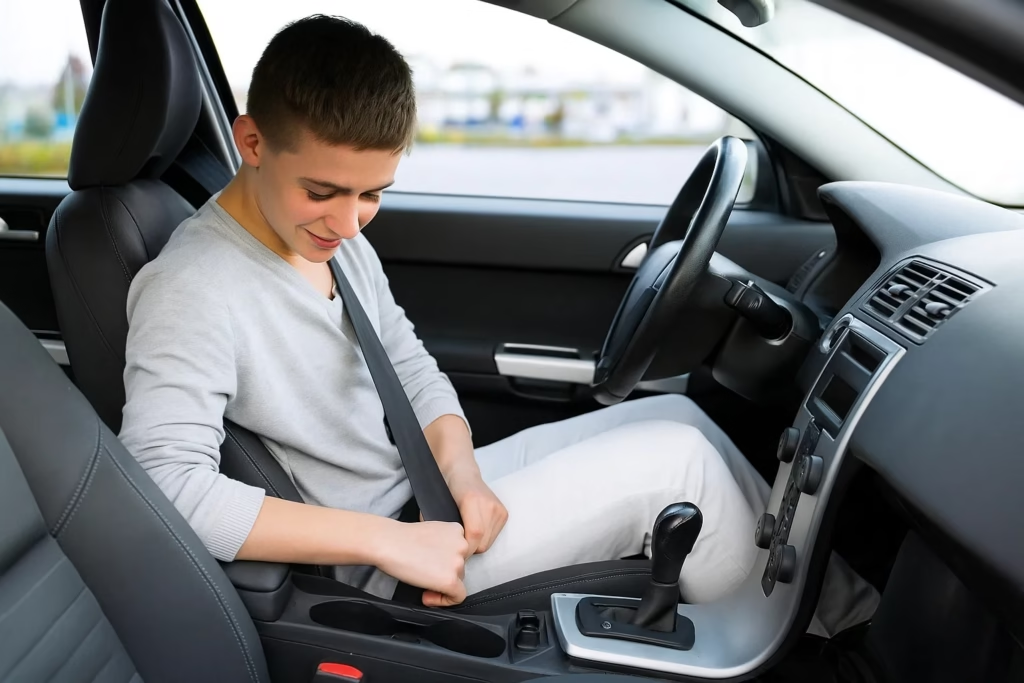
Wearing a seatbelt the wrong way can reduce its effectiveness. Here are a few tips:
The lap belt should sit snugly across your hips, not your stomach.
The shoulder belt should cross your chest and rest on your shoulder, not your neck.
Never tuck the belt behind your back or under your arm.
Make sure it’s not twisted—it should lie flat across your body.
It takes less than 5 seconds to check, and it could save your life.
Legal and Financial Consequences
In most countries, wearing a seatbelt is not just common sense—it’s the law. Getting caught without one can result in hefty fines, penalty points on your license, or even higher insurance premiums. More importantly, if you’re injured in an accident and weren’t wearing a seatbelt, some insurance companies may reduce your compensation.
So, wearing a seatbelt protects you physically, legally, and financially.
Seatbelts for Every Seat – Not Just the Front
Many people buckle up in the front seat but ignore it in the back. This is a huge mistake. In a crash, an unbuckled backseat passenger can be catapulted forward, hitting others or even crushing them. It’s not just about your safety. It’s about the safety of everyone in the car.
Think of it this way: if you don’t buckle up in the back, you’re putting the driver and front-seat passengers at risk too. Being responsible means protecting yourself and not becoming a projectile that can harm others.
Real-Life Scenarios
Imagine two scenarios during a crash at 50 km/h:
Without a seatbelt: You are thrown forward, hitting the steering wheel and windshield with full force. The injuries could be fatal or leave you permanently disabled.
With a seatbelt: You stay in your seat. The seatbelt and airbags work together to absorb the impact. You might have bruises, but you’re alive and likely able to walk away.
This simple strap of fabric can be the difference between life and death.
Tips for Wearing a Seatbelt Correctly
1. Don’t Rely on Airbags Alone
Airbags work with seatbelts, not without them. Always buckle up, even if your car has advanced airbags.
2. Position the Lap Belt Correctly
The lap belt should sit across your hips, not your stomach. This prevents internal injuries in a crash.
3. Position the Shoulder Belt Properly
The shoulder belt should cross your chest and rest on your shoulder, never under your arm or behind your back.
4. Avoid Twisting the Belt
A twisted seatbelt reduces effectiveness during a crash. Make sure it lays flat against your body.
5. Pregnant Drivers and Passengers
Position the lap belt under the belly and across the hips, and the shoulder belt between the breasts and to the side of the belly to protect both mother and baby.
Wearing a seatbelt is one of the easiest safety choices you can make. It doesn’t cost extra. It doesn’t require special training. It takes just a second. Yet, it can save your life, protect your loved ones, and prevent tragedies that could otherwise change lives forever.
So the next time you get into a car, don’t think twice. Don’t leave it to chance. Don’t give excuses. Click that seatbelt. Every trip. Every seat. Every time.
Because when it comes to your life and the lives of the people you love, wearing a seatbelt is truly non-negotiable.
FAQ
Q1: Can I get injured by the seatbelt itself?
When worn correctly, seatbelts prevent serious injuries. Minor bruising may occur, but it’s far safer than being thrown from the car.
Q2: What about backseat passengers?
Everyone in the car must wear a seatbelt. Backseat passengers are not exempt, and unbelted passengers can injure themselves or others in a crash.
Q3: Can I loosen my seatbelt for comfort?
Seatbelts should be snug across your chest and hips. Loosening it too much reduces protection in an accident.
Q4: Are children treated differently?
Yes — children require age- and size-appropriate restraints, such as booster seats or child seats, in addition to a seatbelt.
Discover more from SMOOTHSTEERING
Subscribe to get the latest posts sent to your email.